era 02 / 051991 — 1995
The announcement
Four years in which a student's hobby became a licensed project, a licensed project became a Unix, and a Unix became a distribution you could install without being a specialist.
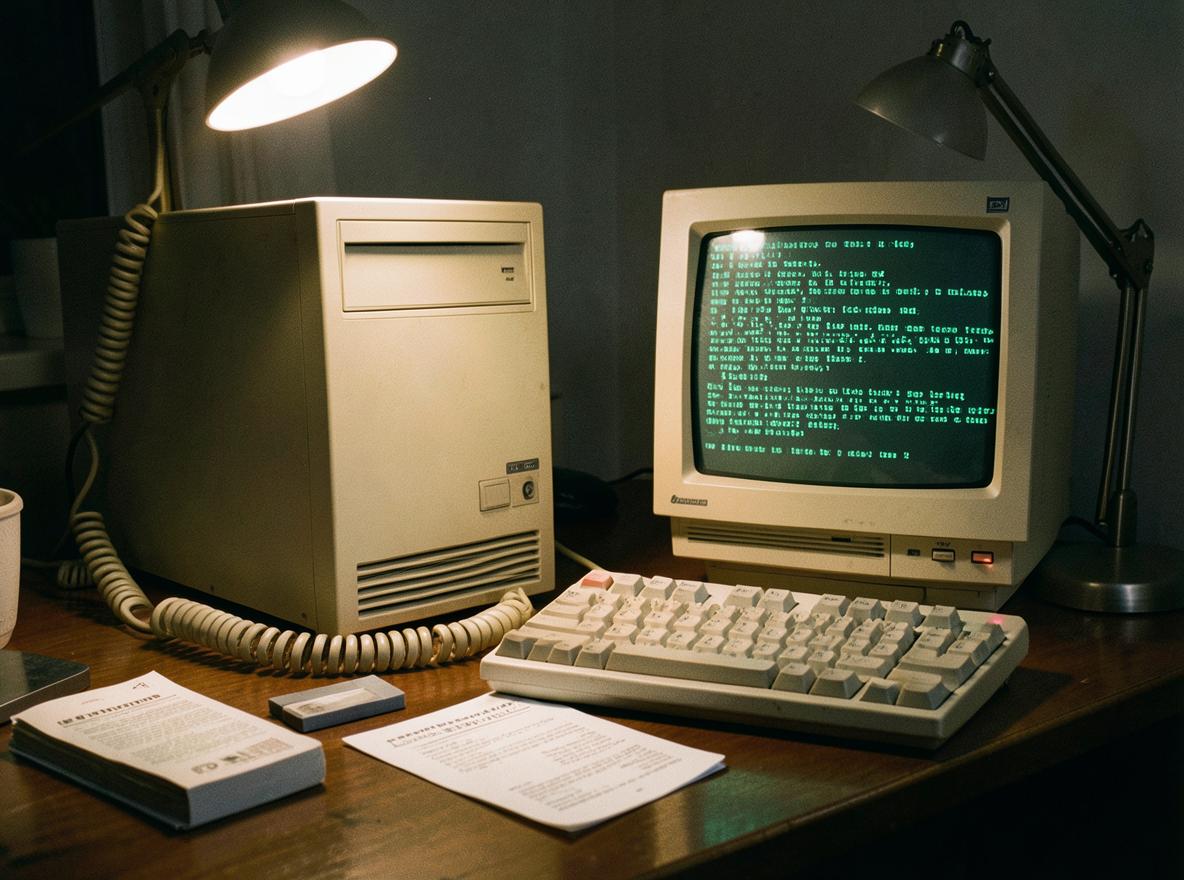
25 August 1991
Linus Torvalds was 21, in Helsinki, and had spent the summer on a terminal emulator for his Intel 386 that he kept extending. He posted to the Usenet group comp.os.minix — the place where people who cared about small Unix clones gathered — to ask what people would want from such a system.
"I'm doing a (free) operating system (just a hobby, won't be big and professional like gnu) for 386(486) AT clones."
The parenthesis is the most quoted sentence in the history of free software, and it is quoted because it was wrong in every particular except one: it was a hobby.
Two things about the post are easy to miss. First, he was not announcing an idea — he had working code. Second, he asked for requirements rather than presenting a finished product. That habit, asking the people who would use it what it should do, is the same habit that still structures kernel development.
17 September 1991: version 0.01
The first release was 10,239 lines of C and assembly. It could not be compiled nor run by most people: it required MINIX to build, and it assumed hardware close to Torvalds's own. The announcement of 0.01 says plainly that it is not portable and probably will not do much.
What it could do was the whole point:
- Multitasking with a real scheduler.
- A filesystem compatible with MINIX's, so there was something to mount.
- Run
bashand compile programs withgcc. - Print its progress to a terminal via the serial port.
A system that runs a shell and a compiler is a system you can develop on. From 0.01 onward, every improvement could be made inside Linux itself — the bootstrap problem was solved on day one.
10,239 lines in 1991. The kernel is now measured in tens of millions of lines and receives roughly ten changes an hour, according to the Linux Foundation's 2026 report.
The licence decision
The original licence was deliberately restrictive: no commercial redistribution. That was a young developer protecting his work, and it made Linux nearly impossible to package or sell.
With version 0.12 in February 1992, Torvalds relicensed the kernel under the GNU General Public License. The consequences were structural:
- Anyone may use, modify and sell Linux. The GPL restricts distribution of the code, not its use or its price.
- Modifications distributed to others must be shared under the same terms. Improvements cannot be taken private.
- The kernel and the GNU userland finally shared a licence, which is why a complete system could be assembled legally — and why the name "GNU/Linux" exists.
This is the decision that made the business models of the next era possible: Red Hat could charge for support and packaging precisely because the licence prevented anyone from locking the code away.
The microkernel argument
In January 1992 Andrew Tanenbaum posted a critique on comp.os.minix: Linux was monolithic, obsolete in design, and would not survive the move to newer hardware. Torvalds replied that a design that worked was worth more than one that was elegant in theory, and that MINIX's own limitations were the reason he had started.
The argument was about where to put complexity. A monolithic kernel keeps drivers, filesystems and networking in one address space — fast, but a bad driver can take down the machine. A microkernel pushes services into separate processes — isolated, but historically slower because of message passing.
Linux kept the monolithic shape and borrowed the useful half of the other idea: loadable kernel modules let drivers be added and removed at runtime, and user namespaces later moved some risky work out of the kernel's address space. The design that "would not survive" is now in every one of the 500 fastest supercomputers.
The first distributions
Kernel plus GNU tools plus a bootloader plus a package system, correctly assembled, was still a week of work for an expert. Distributions turned that week into an installation.
- 1992 – SLS (Softlanding Linux System) proved the format existed, and was rough enough to inspire its own replacements.
- 1993 – Debian, founded by Ian Murdock, was open in governance from the start: a constitution, a social contract, and a package system (
dpkg, thenapt) that survived decades. - 1993 – Slackware, by Patrick Volkerding, stayed deliberately close to Unix conventions and let you see everything.
- 1994 – Red Hat and SUSE began building businesses around packaging and support.
The split is still visible. Debian's descendants include Ubuntu; Red Hat's line leads to Fedora, RHEL and CentOS Stream; SUSE serves European enterprise; Arch and Alpine answer different questions again. The Terminal Lab teaches apt, the Debian-line tool, but the concepts transfer directly to dnf or pacman.
14 March 1994: Linux 1.0
Version 1.0 arrived with 176,250 lines of code. It had a networking stack, a virtual filesystem layer that could host several filesystem types at once, and a level of reliability that people were willing to trust with work.
By then the shape of the project was also fixed: patches on a mailing list, a maintainer who merged them, releases announced publicly. Version 1.2 followed in 1995, and the kernel had outgrown its author's original scope entirely.
The next problem was not technical. A serious Unix that could run on cheap hardware threatened the commercial Unix vendors, and the argument about whether it was safe to adopt had to be won outside the project. That is the next era.